
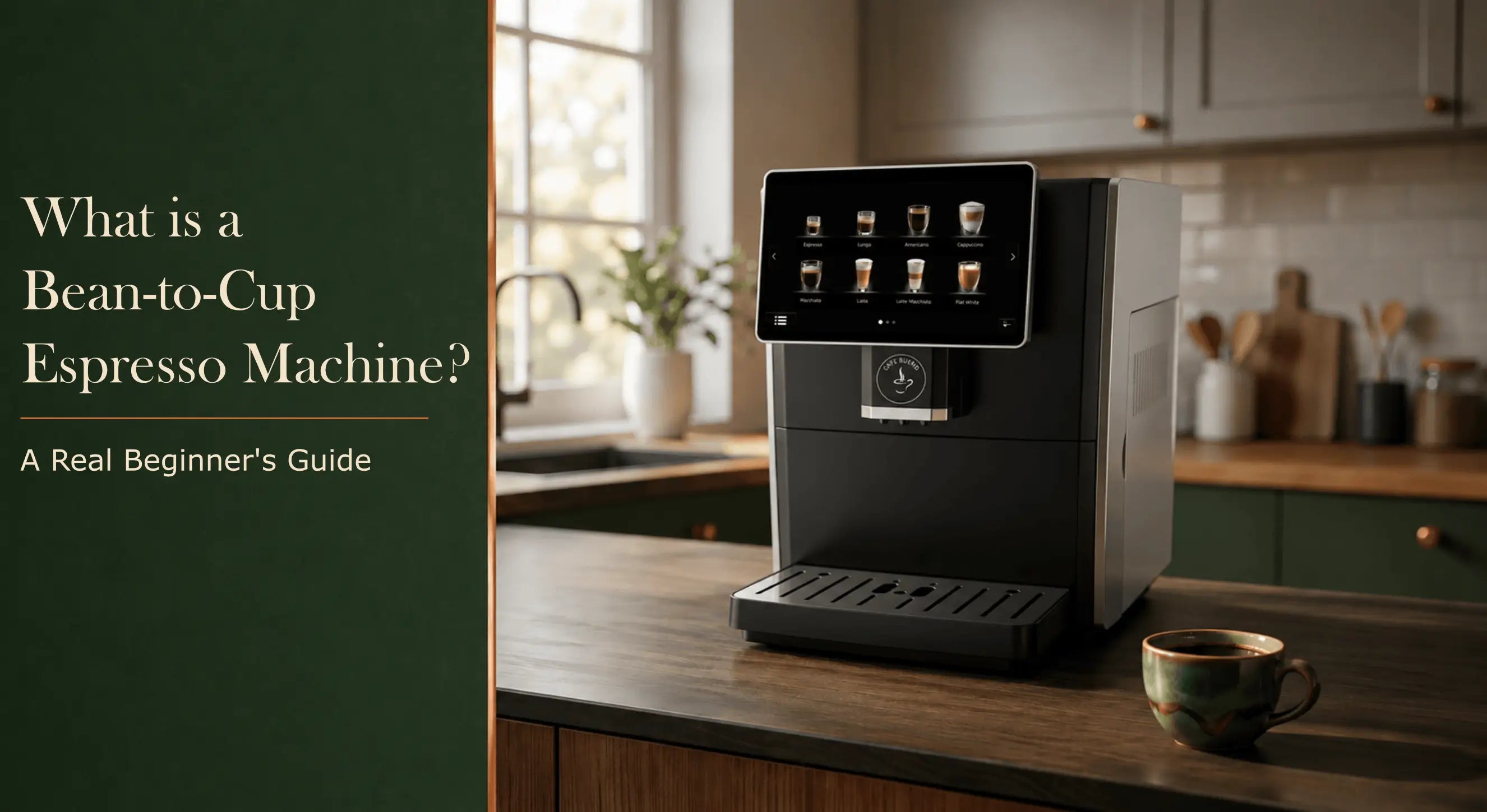

The home espresso machine market has a vocabulary problem. Terms like 'super automatic,' 'bean-to-cup,' 'semi-automatic,' 'pod machine,' and 'capsule machine' get used interchangeably across Amazon listings, appliance store floor tags, and coffee review sites, and almost nobody explains what any of it actually means. Most buyers end up making decisions based on price and looks rather than understanding what they're actually choosing between.
If you've heard 'bean-to-cup' and weren't entirely sure what it meant, you're in very good company. Here's a plain-English explanation of what these machines are, how they work, who they're genuinely right for, and where they fall short.
What Bean-to-Cup Actually Means
A bean-to-cup machine does exactly what the name says: it takes whole coffee beans and turns them into a finished cup of coffee, all in one machine, without you doing anything meaningful in between. You load whole beans into the hopper on top, fill the water reservoir, and press a button. The machine grinds the beans, measures the dose, tamps them with consistent pressure, pulls the espresso shot through hot water, and on most models, froths the milk automatically as well.
Bean-to-cup is essentially another term for what's also called a 'super automatic' espresso machine. The two terms describe the same category, every step of the espresso-making process is automated inside one device. When you see either phrase, you're looking at the same type of machine.
How It's Different from Other Machine Types
Pod or capsule machines, Nespresso, Keurig, and similar systems, are the most convenient category of all. But they use pre-packaged coffee in sealed pods. The coffee inside was ground before you bought it, which means it's been losing flavor compounds since the moment it was packaged. By the time it reaches your cup, the freshness that makes good espresso taste the way it does is largely gone. These machines are genuinely convenient. They're also not making good espresso by any serious measure.
Semi-automatic espresso machines have a pump and a boiler, but you grind the beans separately with a standalone grinder, fill and tamp a portafilter by hand, attach it to the group head, and manually start and stop the extraction. It should be noted that you can find a semi-automatic machine with a built-in grinder, but most of the time you are still tamping the grounds, or at a minimum you are frothing your own milk. A lot of serious espresso enthusiasts love this format, the hands-on control is exactly the point, and getting good at it is part of the appeal. But there's a real learning curve. Most people aren't making anything drinkable on a semi-automatic in the first week, and even after that, inconsistent technique produces inconsistent results.
Drip coffee makers are a different category entirely. They're not making espresso, they're making filtered coffee through a fundamentally different brewing method. Comparing a drip machine to a bean-to-cup machine is like comparing a wok to a slow cooker. Both cook food, but they're not interchangeable.
Bean-to-cup machines sit in the middle of the spectrum. More convenient than a semi-automatic and producing significantly better coffee than a pod machine. The trade-off against semi-autos is control; the trade-off against pods is price and cleaning. Whether those trade-offs work in your favor depends on what you actually want from your morning coffee.
How the Grinder Works Inside the Machine
This part surprises a lot of people who are new to the category. The grinder inside a bean-to-cup machine is doing real, meaningful work, it's usually a burr grinder, the same type used in specialty coffee shops, just built directly into the machine housing.
When you press the button for an espresso, the machine pulls a measured amount of beans from the hopper, grinds them to a specific consistency, doses them into the brew chamber with a precise amount, tamps them under consistent pressure, and begins the extraction. The grinder settings, coarseness and dose amount, are adjustable, which is why you can dial in how strong or mild you want your drinks without changing anything else.
On machines like the CB-3000 and CB-3500, the ceramic burr grinder has multiple adjustable grind settings and is built to maintain performance over daily use. Ceramic grinders last longer than steel ones under continuous use and don't transfer heat to the grounds during grinding, which sounds like a minor technical point but has a real effect on flavor, particularly with more delicate medium roasts.
The Honest Pros and Cons
The case for a bean-to-cup machine is strong: it delivers consistency and convenience that's genuinely hard to match in a home setting any other way. Once you've set up the machine and dialed in the settings you like, you'll get the same cup every morning without thinking about it. No skill required, no particular technique to maintain. You're using fresh whole beans, which means actual espresso flavor rather than the stale ghost of espresso flavor you get from pods. And when you put a cup down in front of a guest without doing anything more than pressing a button, they tend to be impressed.
The honest downsides: the price of entry is higher than a pod machine. They require more cleaning than pod systems, a real and non-trivial commitment. They're less precise than a skilled barista using a semi-automatic, if you're deeply into espresso as a craft and want to extract every nuance from a particular single-origin bean, you may eventually find the automation limiting. And they're physically substantial, a bean-to-cup machine is a real presence on a countertop and isn't something you'll tuck away in a cabinet between uses.
Who It's Right For
The people who get the most out of bean-to-cup machines are busy households where one or more people drink espresso-based drinks every day and don't want to spend 15 to 20 minutes making them. Households where different family members want different drinks, someone wants espresso, someone wants a latte, someone wants a cappuccino, and the machine handles all of it without requiring different skill sets from different people.
It's also genuinely well-suited for someone transitioning away from Nespresso or Keurig. If you've been using a pod machine and you know you want meaningfully better coffee but you also know you're not going to become a semi-automatic enthusiast, bean-to-cup is the right middle ground. You take a real step up in coffee quality without giving up the convenience that made the pod machine appealing in the first place.
Home offices fit this category well too. If you're working from home and you're going through three or four drinks a day — and a lot of people are — the economics and the daily experience of a good bean-to-cup machine start making a lot of sense relatively quickly.
Who It Might Not Be Right For
If you drink one cup of black drip coffee in the morning and that's the extent of your coffee life, a bean-to-cup machine is significant overkill in both price and complexity. A quality drip machine will serve you better.
If you're genuinely passionate about espresso as a craft — if you want to pull shots manually, experiment with different tamping pressures, chase specific extraction yields, and obsess productively over dial-in — a semi-automatic with a standalone grinder is probably more satisfying long-term. The control is the point for that type of enthusiast, and a machine that automates everything away from you will eventually feel limiting.
If you travel constantly and make coffee at home sporadically — a few times a week at most — the cleaning demands of a bean-to-cup machine are going to become annoying fast. These machines need consistent use and regular maintenance. They don't sit well neglected in a corner for two weeks. If you're going to be away from home regularly, factor that in honestly.
Where to Start
If you've read this far and concluded that yes, a bean-to-cup machine sounds like the right fit, the natural next question is which one. Without turning this into a full buying guide, the CB-3000 is a sensible starting point for most households, 19 drink types, support for all milk varieties, a 7-inch touchscreen that makes navigation genuinely intuitive, and a price point that doesn't require you to take out a second mortgage on the kitchen. The CB-2000 is worth considering if you want a lower entry point and want to confirm you'll use the machine heavily before stepping up.
One thing tends to be consistent among people who make the switch to bean-to-cup from pods or drip: going back feels like a meaningful downgrade after a few weeks of fresh-ground espresso every morning. That's not universal, but it's common enough to be worth noting. Most people who make the jump don't end up regretting it.
Share:
How to Actually Clean Your Super Automatic Espresso Machine
How to Descale Your Espresso Machine: A Complete Step-by-Step Guide